
BECALMED
A second shock approaching a food and freight system whose reserves are already drawn down. Who is stocked, who is bare, and when it lands.

STRATEGIC ADVISORY BRIEF
M Nadal & Co Strategic Advisory | 24 June 2026
Stress-scenario analysis. A thesis to be tracked and falsified, not a forecast. The falsifiers are part of the intelligence. This brief covers a wide system, food, freight, fertiliser, currencies, because the thesis is about how a shock transmits across them, not about any single market. The weights and emphases here are a starting position. They will be refined as the falsifiers resolve and elements confirm or break.
Verified Confirmed data at time of writing.
Inferred Conclusions from documented mechanisms and prior analogues.
Inferred, low confidence Where the link is genuinely weak, stated explicitly.
Scenario The logical consequence of the structure if the inferred relationships hold.
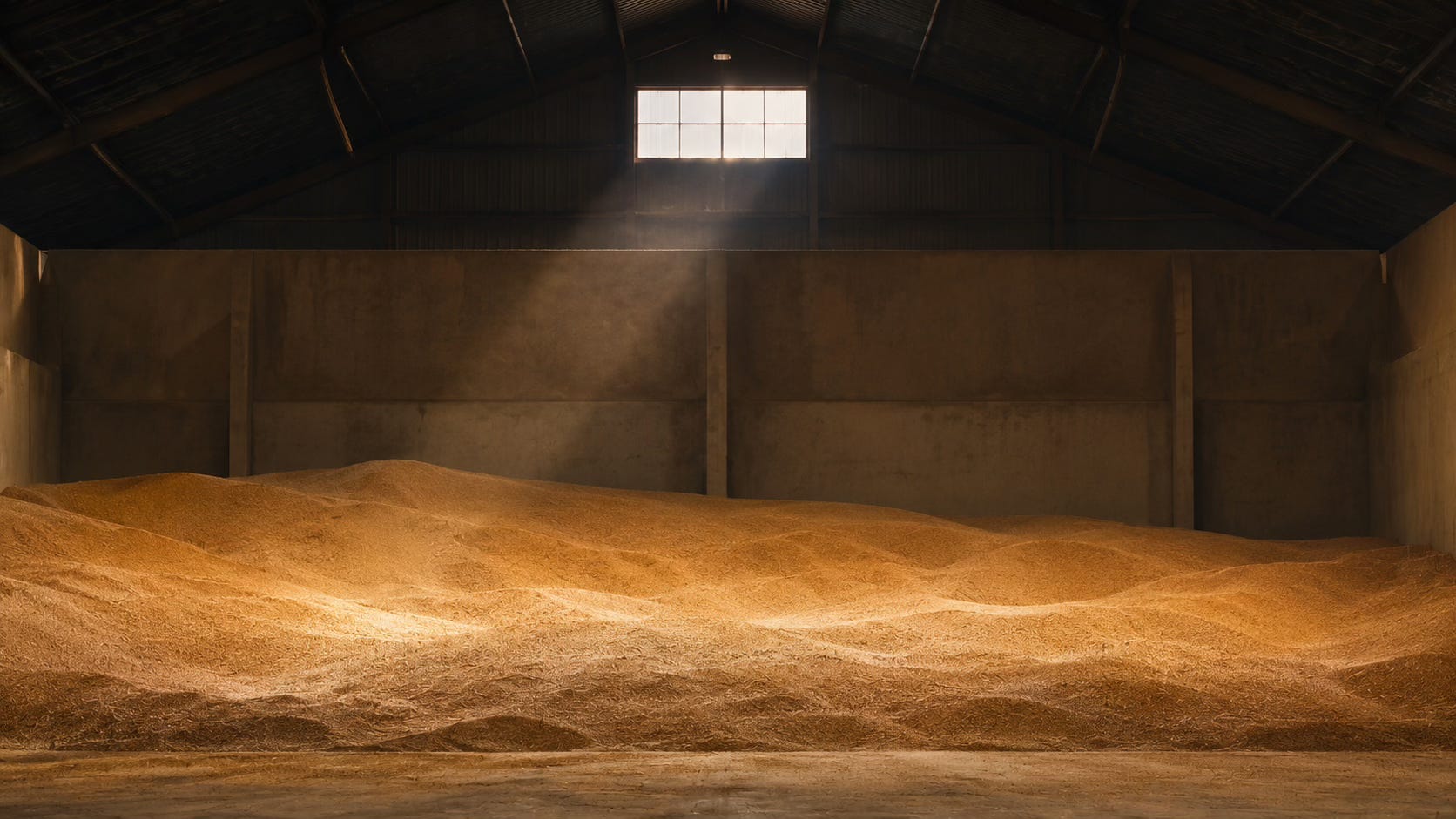
This brief is about food and freight, and the reserves that stand between a weather event and a price shock. Grain in store, fertiliser pre-bought, water in a canal.
A reserve does two things. It redistributes a shock: the actor with full stores is spared, the one without takes the loss undiluted. And it defers a shock: it moves the pain later in time without cancelling it.
A developing El Niño, with above 90% probability of strengthening to strong or very strong by late 2026, is approaching a global food and freight system that has already spent five months absorbing a fertiliser and energy shock through a contested Strait of Hormuz. The buffers that held that first shock are thinner now than they were in February. The second shock has not yet arrived.
El Niño is not one-directional. It stresses Asia and the Maritime Continent, but the same pattern decides the South American crop the rest of the world is counting on to absorb that stress. South America is the valve between a regional shock and a global one.
The question this brief answers is not whether El Niño will be severe. It is whether the reserves will have refilled before it bites. That question can be partially answered today, because reserve levels are present-tense facts, not forecasts.
The forward curves have not yet priced a strong El Niño. Palm, robusta and fertiliser still trade on a neutral assumption, and South America is not yet priced as the offset valve either. That gap closes when the August monsoon revision and the September fertiliser print confirm the damage.

WHAT WAVE ONE CONSUMED
Verified Since February 2026, the Gulf has supplied roughly a third of internationally traded fertiliser through a contested strait. Qatar suspended urea, ammonia and sulfur output. Iran halted ammonia production. Urea (Middle East FOB granular benchmark) broke above $850 per tonne in April, up 80% since February. Gas accounts for 80-90% of ammonia production cost. The energy shock and the fertiliser shock are the same shock with a lag. IFPRI’s 21 May 2026 update models fertiliser trade returning to roughly 50% of normal by August 2026, 75% by early 2027. Full normalisation is a 2027 story on the optimistic path.
The fertiliser that growers need for the next planting cycle is being priced and sourced now, against a supply system that is still short. The input damage to this cycle is already banked. Whether the strait reopens next week does not change what was planted, or not planted, in the last three months.
TRANSMISSION
These are sequence and lag, not calendar. The order is the claim; the week counts are nominal.
Weeks 1-4: Power and gas (fast, noisy, weakest attribution)
Inferred, low confidence Australia enters winter under a developing El Niño. Settled high-pressure regime suppresses wind and hydro. Thermal load rises from both ends: less generation, more cooling demand. The marginal gas unit clears the price. The signal is real. The attribution to El Niño specifically is the weakest leg here, and should not be traded as confirmation.
Weeks 2-8: Forward markets price the agriculture legs
Inferred Palm oil and robusta coffee futures begin moving before yield data confirms anything. Traders are pricing the Maritime Continent drought probability, not the outcome. This is the window for positioning: after the signal is visible, before the physical impact arrives. Malaysian fresh fruit bunch output is already down year-on-year on the latest monthly read. The forward curve is not yet reflecting a strong El Niño. That gap is the opportunity.
